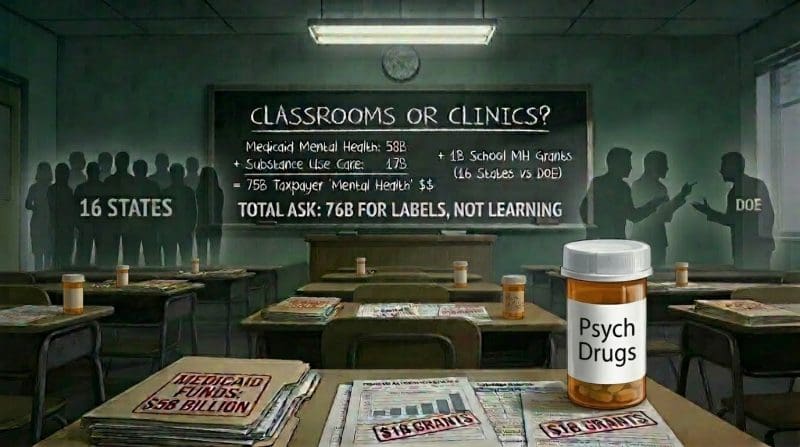
Classrooms or Clinics? 16 States vs. DOE in a $1 Billion Lawsuit on Top of $75 Billion in Mental Health Spending
The Department of Education (DOE) under President Trump decided that $1 billion in Biden-era federal grants to schools for increased mental health services conflicted with the President’s budgetary priorities and pulled the funding. Sixteen states took offense to losing the extra cash and filed a lawsuit to get the mental health money back. The question is why states are whining about $1 billion in mental health grants when so many are swimming in mental health money already budgeted through mandatory federal programs.
How much money will the taxpayers be on the hook for mental health services? Seriously, when will mental health funding be enough? The fact is the extra $1 billion in mental health funding the states are fighting over is separate from the $58 billion in mental health funding appropriated through Medicaid, which also includes another $17 billion of substance abuse care.
That’s 75 billion real federal tax dollars already being spent on mental health services in states. Taxpayers, through Medicaid, provide more than $8 billion annually for direct school-based mental health services, screenings and therapies. And children with mental health conditions account for 55% of all Medicaid spending for children aged 3-17. In other words, not only are taxpayers on the hook for mental health services covered by mandatory Medicaid funding but they also dish out $8 billion for direct school mental health interventions. Why? Why are schools becoming mental health detection and intervention clinics?
Increased funding for mental health seems to be a never-ending, ever-increasing burden that taxpayers are forced to pay even though nobody is getting better. Look at the facts, every year the number of people being diagnosed with a mental illness increases as does the number on psychiatric drugs prescribed as “treatment.” Currently one in five American adults is being treated for at least one mental disorder. The same is true for one in five US children aged 3-17 (twenty million) have also been diagnosed with a mental disorder.
And the kicker is that the mental health industry cannot prove that any mental disorder is an objective confirmable abnormality in the brain. That’s right. No abnormality that is being “treated.” Mental disorders are based on lists of alleged abnormal behaviors voted into existence by the very industry that gets paid to “treat” them. Most people would call that a conflict of a very dubious nature. And, further, the pharmaceutical companies who produce the drugs used as “treatment” for the made-up mental disorders haven’t got a clue how the drugs “work” in the brain as “treatment.”
Regardless, the most recent data shows that in 2019, for example, nearly 44 million American adults – a little more than 17 percent of the adult population – reported expenditures for the treatment of mental disorders, medical spending to treat adults with mental disorders totaled more than $106 billion and the number of females with expenses for mental health treatment was almost double that of men. Go figure, there’s no abnormality that can be identified but everyone has a mental disorder that has to be “treated.”
And given that there is no proof of an abnormality, the real problem is that the federal government, through taxpayer funds, is complicit in this mental health fraud by financially supporting the “treatment” of mental disorders that cannot be proven as an abnormality. Does the federal government pay, through Medicaid and Medicare, for cancer treatments that the doctor cannot prove the disease exists? Imagine how that would work for a moment. Can’t prove the disease (cancer) is in the body but we’ll pay to treat it. Clearly, it’s ridiculous.
But now let’s consider the states that are doing a lot of the whining about not getting their portion of that extra $1 billion mental health funding. Washington, along with Illinois, and New York are all complainants in the $1 billion dollar lawsuit against the DOE. All three of these states claim sanctuary status – obstructing immigration enforcement – and spend tens of millions of dollars on medical care (including mental health) for low-income migrants. Nearly $175 million in Washington, more than $1 billion in Illinois and more than $2 billion in New York is spent on illegal immigrant health care services.
These states, that clearly obstruct federal law in their protection of illegal aliens, have the unmitigated gall to sue the DOE for additional mental heath funding. But it gets worse. These same states have no problem suing the federal government for additional mental health funding for schools that simply are a failure when it comes to educating its population.
For example, in Illinois, and specifically Chicago, enrollment in school has dropped by approximately 10% (200,000) students, more than 70 schools have been closed due to declining enrollment and one in five students is chronically absent from school. And as of 2024-2025 275 Chicago Public Schools were considered underutilized (below 70% of the school’s ideal capacity).
And one “school,” Frederick Douglass Academy High School, enrolled just 27 students with 28 full-time staff. That’s right. More staff than students. In 2024, operational spending at Douglass exceeded $93,000 per student but still not a single 11th grade student was proficient in math or reading. More than 65% of Douglas’s students are chronically absent and fewer than one dozen is reported to show up with any regularity.
But don’t fret. By anyone’s measure, this completely useless High School has at least two mental health staff members and three support staff, including a Restorative Justice Coordinator (whatever that is), Case Manager and a college and career coach. How many other schools in the Chicago area and other states that are just as useless will be sucking on the federal mental health teat?
The very liberal 9th Circuit Court of Appeals has ruled in favor of the states, stating that “the department failed to make a strong showing that it engaged in the reasoned decision-making required.” The Court of Appeals decision does not require the DOE to release any funds but, rather, asks that the federal agency provide the states with better explanations for withholding the grant money.
AbleChild would guess that a simple answer of “first do a better job educating before attempting to dabble in mental health” wouldn’t be acceptable. But it would be an honest response. Better still, how about everyone agree that America’s school-age children should not be a playground for psychiatric experimentation.


Post a Comment